What do people ask ChatGPT about blinds, and how do you answer?

What do people ask ChatGPT about blinds, and how do you answer?
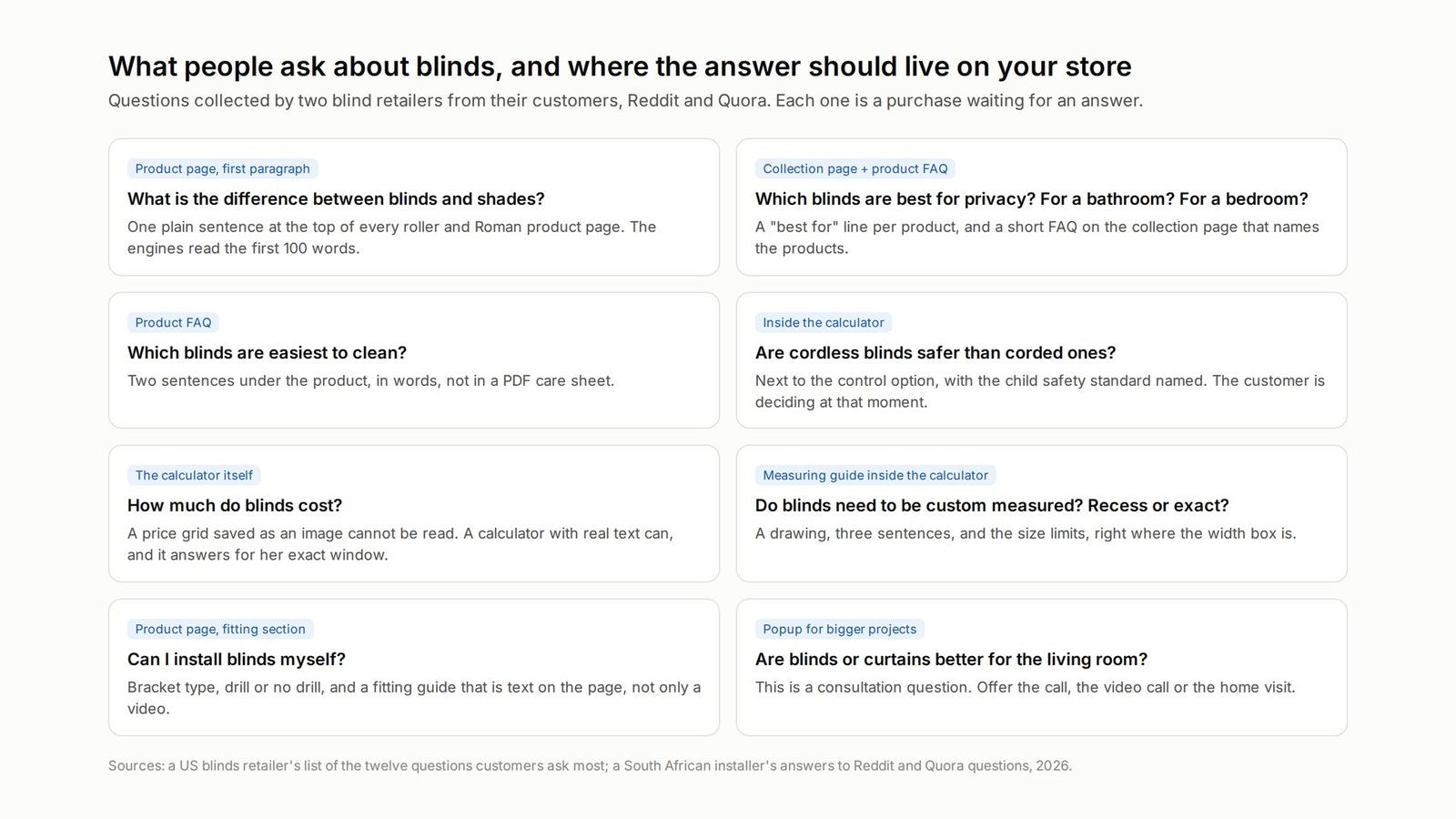
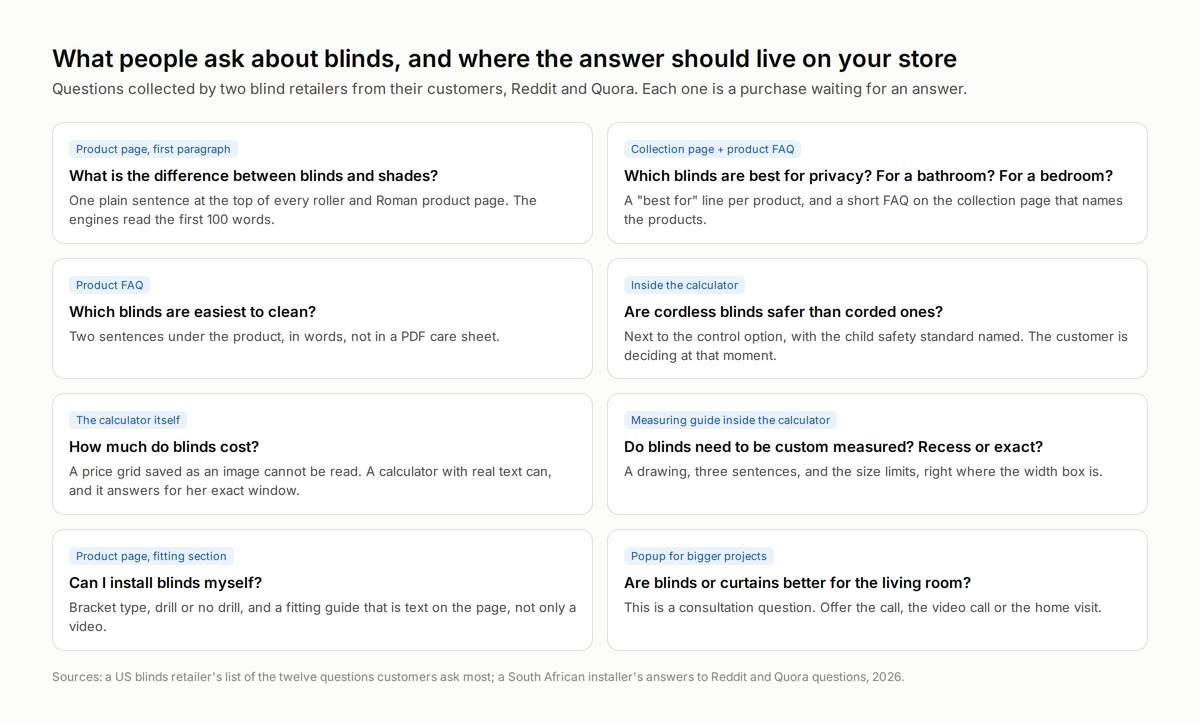
They ask the same questions they used to ask in the shop. What is the difference between blinds and shades. Which blinds are best for privacy, for a bathroom, for a bedroom. Which are easiest to clean. Are cordless blinds safer. How much do blinds cost. Do they need to be custom measured, and recess or exact. Can I fit them myself. Blinds or curtains for the living room. Two blind retailers, one in the United States who collected the twelve questions customers ask most and one who answered questions gathered from Reddit and Quora, ended up with almost the same list. Your store becomes the answer when each of those questions is answered in plain text on the page where the customer is deciding, and when the price is real text a machine can read, which means a calculator, not a price grid saved as an image.
Why does it matter where the answer lives?
Because AI engines answer from pages they can read, and they quote the page that answered the question closest to where it was asked. When a homeowner asks ChatGPT, Perplexity or Gemini "do blinds need to be custom measured", the engine finds pages that answer that question in the first hundred words and cites one of them. If your measuring guide is a PDF, or a video, or a page that opens with three paragraphs about your family business before it gets to the point, the engine quotes somebody else and the customer clicks through to them.
The rule we follow on our own pages and the pages we build for retailers is simple. Every question gets its own heading, phrased the way the customer would type it, and the answer is the first sentence under it. That is not a trick for machines, it is how a good shop assistant answers, and it happens to be exactly what the engines reward.
Which questions belong on the product page?
The ones the customer asks with her hand on her purse. What is this blind good for and not good for, in one sentence at the top. Which sizes it comes in and what happens outside them. Recess or exact, with a drawing, next to the width box. Whether the chain is child safe and what the standard is, next to the control option, because in the UK every corded blind sold for a home has to meet BS EN 13120 and customers who have small children do ask. How to clean it, two sentences, on the page, not on a care sheet. Whether she can fit it herself, with the bracket type and whether it needs drilling.
Notice that half of those live inside the calculator. The measuring guide, the size limits, the child safety line and the fitting type are questions the customer asks at the moment she is choosing, so the calculator is where the answer goes. A calculator that is a widget of boxes cannot hold them. One that is a guided page can, and we showed what that looks like in the piece on calculator design.
Which questions belong on the collection page?
The comparison questions. Which blinds are best for a bathroom. Blinds or shades. Blinds or curtains for the living room. Which are easiest to clean. These are answered once, on the roller blinds page or the bathroom blinds page, with the products named, and every product page links back to them. A short FAQ on the collection page, five questions, each with a two sentence answer that names a product, does more for AI visibility than a blog post nobody finds, because the engine can quote it and the reader can buy from it in one click.
Why is the price the biggest question of all?
Because "how much do blinds cost" is the most asked question and almost no retailer answers it in a way a machine can read. A price grid uploaded as a JPEG is invisible. A "from £29" is an answer to a different question. A PDF price list is text, but it is not on the product page and it does not know the customer's window. A calculator answers the question for her exact window, in text, on the page, and that is the only version of the answer that turns into an order. The market data says most blinds are still sold offline, more than four in five in 2024 according to Grand View Research, and the online share is growing faster than the rest. The stores that grow with it are the ones whose product pages can answer the price question.
Where does AI help a retailer here?
This is the part of the job AI is best at. Give it your product list and the twelve questions and it will draft the answers in plain words, in your voice, for every product and every collection, in an afternoon, and it will draw the calculator that holds the measuring guide and the safety line in the right place. Let it. What it cannot do is know your prices, your size limits, your lead times and your rules, and those are the facts the answers are built on. The words can come from AI. The facts come from your shop, and the price comes from your grid through the app. That split is what makes the page both readable by a machine and true.
Frequently asked questions
Do AI engines really read product pages?
Yes. ChatGPT, Perplexity, Gemini and Google's AI answers all cite specific pages, and product pages with clear text answers are cited for product questions.
Is a FAQ on a product page enough?
It is a good start. The answers have to be real text on the page, phrased as the question is asked, with the answer first, and the price has to be text as well, which is what the calculator provides.
Should the measuring guide be a video?
Have the video, but write it out as well. Engines do not watch videos, and a customer at 11pm on her phone often does not either.
Does the child safety line matter for AI?
It matters for the customer first. It also happens to be a question people ask engines, and a page that names the standard next to the control option is the page that gets cited.
How long until a store gets cited?
Weeks, not days. Crawling happens within days of a page changing, and citations follow when the page keeps answering the question better than the alternatives. Anyone promising AI visibility in a week is selling something.
This week's earlier pieces covered which Shopify app prices blinds by size, why the design can come from AI but the price cannot, how a price grid works, what a production ready order needs and how curtains are priced.
Which of the twelve questions does your product page answer today, in text, without a click?
1reading now
Watch & subscribe
Curtain & Blind Calculator also publishes on YouTube
1.24K subscribers
One click subscribes you on YouTube - you stay here on PUBlish.
Get an email when Curtain publishes