Should a made to order shop use Shopify variants, a product options app or a price calculator?
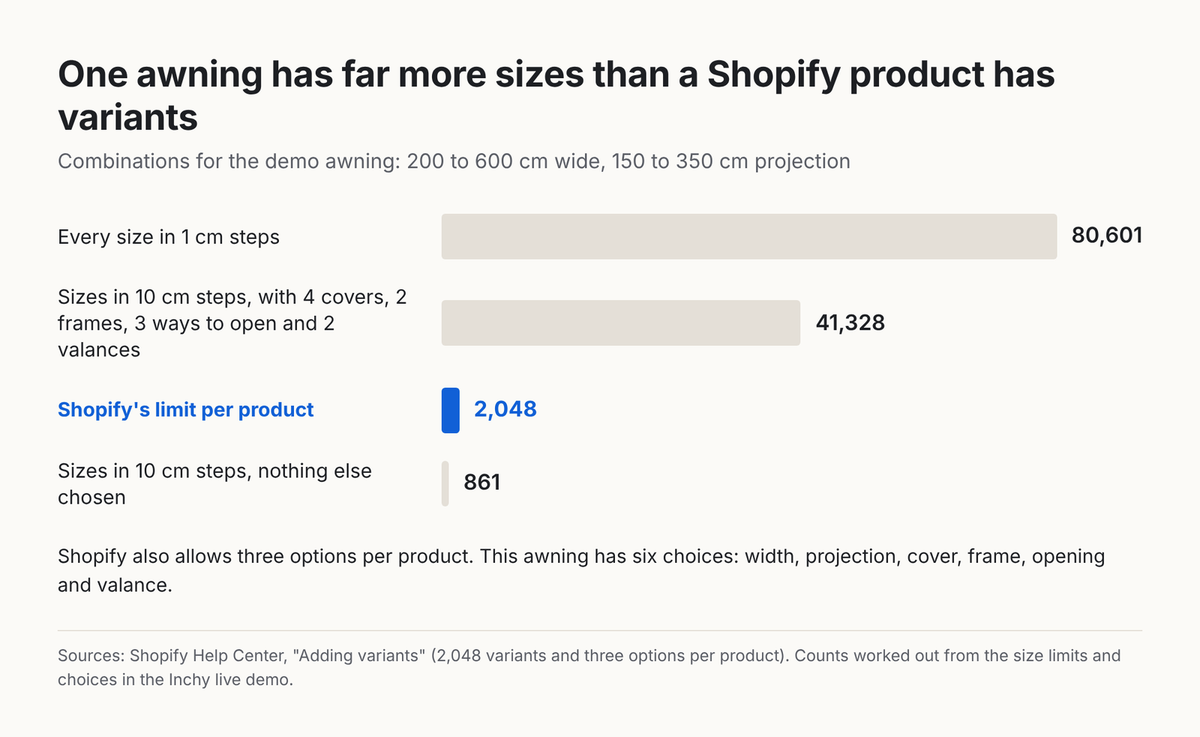
On 15 October 2025 Shopify raised its limit from 100 to 2,048 variants per product. That is plenty for stock. It is still nowhere near enough for an awning made to the centimetre: 200 to 600 cm wide and 150 to 350 cm projection is 80,601 sizes before anyone picks a cover.
Should a made to order shop use Shopify variants, a product options app or a price calculator?
Start from how the product is priced. If it comes in a few set sizes and colours with one fixed price for each, use Shopify variants. If it is stock with a few extras at set prices, variants plus a product options app will do. If the price depends on a size the customer types, or one order covers many sizes at a team price, you need a price calculator that reads the size, prices it from your own list and charges the same at checkout. Inchy is that kind of app, for awnings, outdoor shade and team wear.
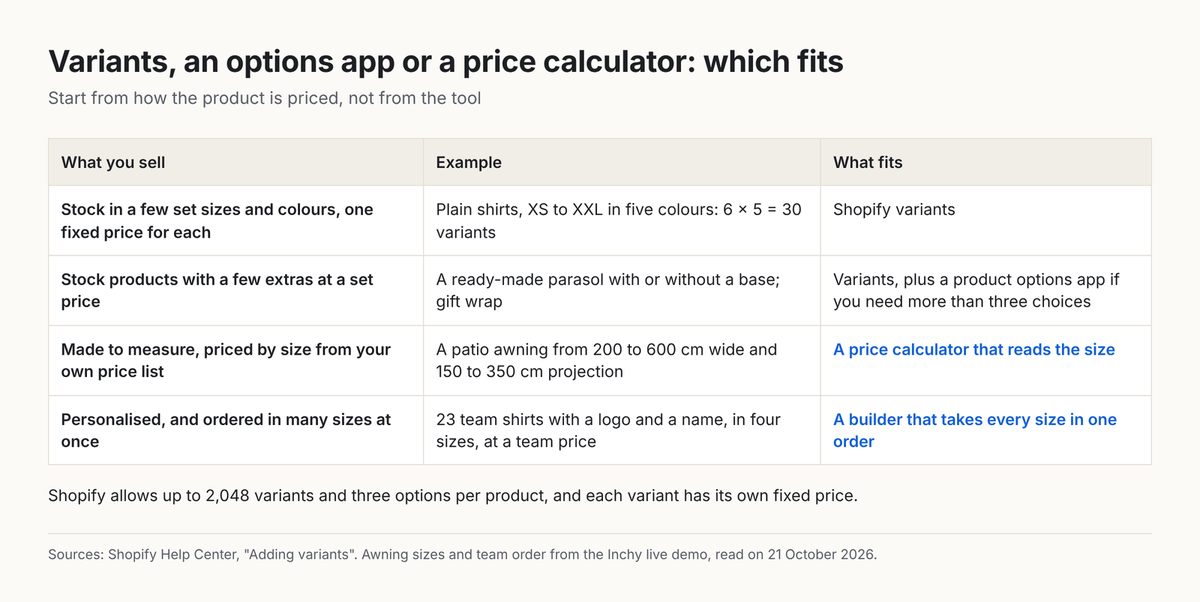
The question is how the product is priced. The tool follows from that.
When are Shopify variants enough?
When you sell stock. Shopify's Help Center says each product can have up to 2,048 variants and up to three options, and each variant gets its own price. Plain shirts in six sizes and five colours are 30 variants, each with a price, a stock count and a SKU. Nothing else is needed.
Shopify is also plain about where variants stop. Its own help page says that to create a product with more than 2,048 variants or more than three options, you can use a third-party app from the Shopify App Store, or customise your theme code to collect line item properties.
Where do variants stop working for made to order?
In three places.
Too many sizes. The demo awning in 1 cm steps has 401 widths times 201 projections, 80,601 sizes. Even in 10 cm steps it is 861 sizes, and with 4 covers, 2 frames, 3 ways to open it and 2 valances it reaches 41,328.
Too many choices. That awning has six choices: width, projection, cover, frame, opening and valance. Shopify allows three options.
One fixed price per variant. A winter cover cut to the width should cost more on a wider awning. A variant cannot know the width.
Line item properties are Shopify's way of carrying custom information on a basket line, such as the size the customer typed. On their own they are a note, a name and a value. Shopify's developer documentation says changing a line's price is done through its Cart Transform API, and that only development stores or stores on a Shopify Plus plan can use apps with its update operations. So a size typed into a property does not, by itself, change what the customer pays.
What does a product options app add?
A product options app adds choices and price add-ons to a product, such as extra fields and extras at a set price. For stock with extras, such as a ready-made parasol with or without a base, or gift wrap on a shirt, that can be all you need.
Before you use one for made to measure, check five things on your own product and your own Shopify plan:
Can it price any size you allow from your own grid, by the square metre or by the metre?
Does it stop sizes you do not make before payment?
Does the checkout charge exactly what the page showed?
Can one order take every size of a team order, with the team price counting every shirt?
Does every choice reach the order in a form your workshop can work from?
What does a price calculator do differently?
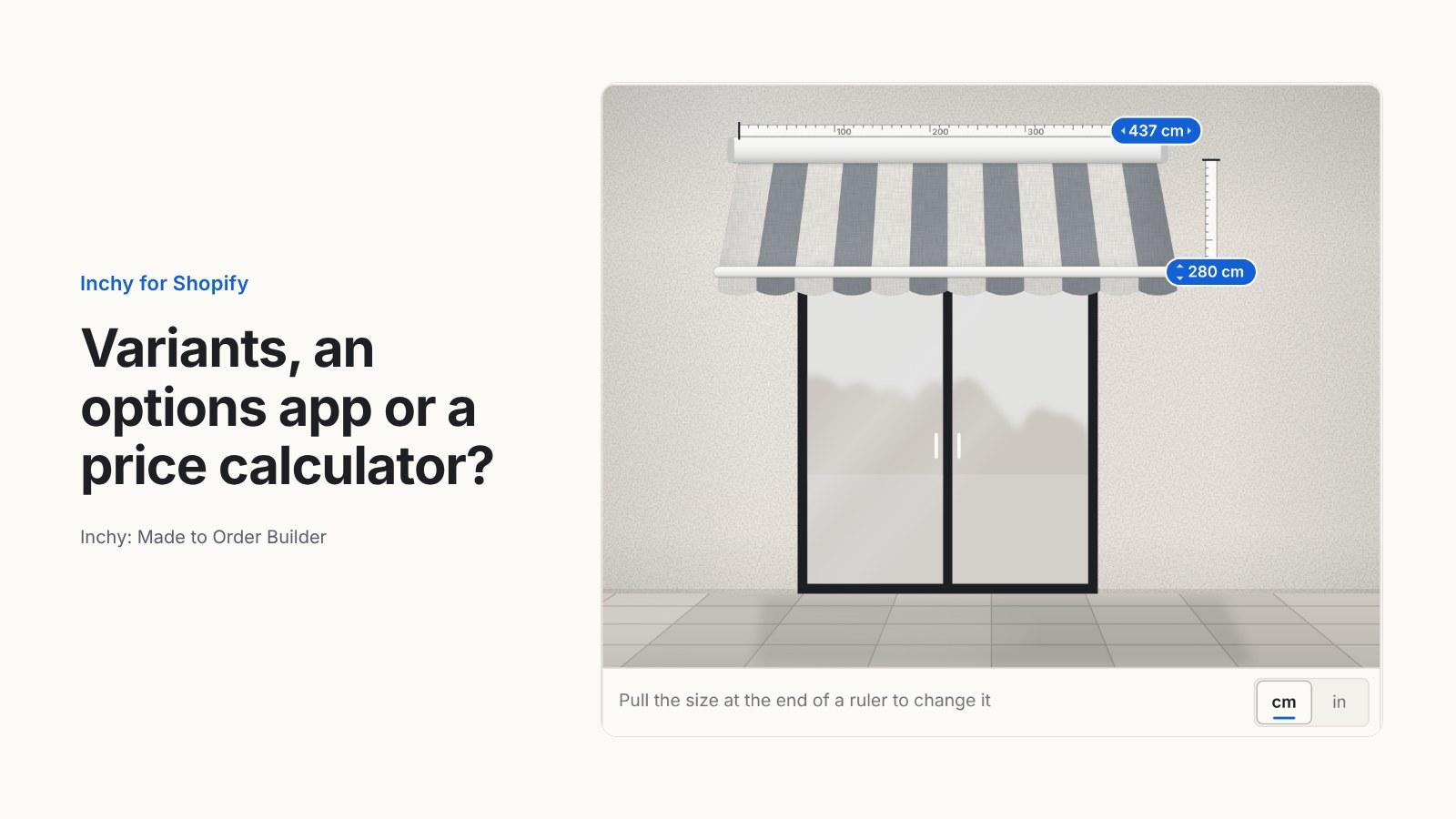
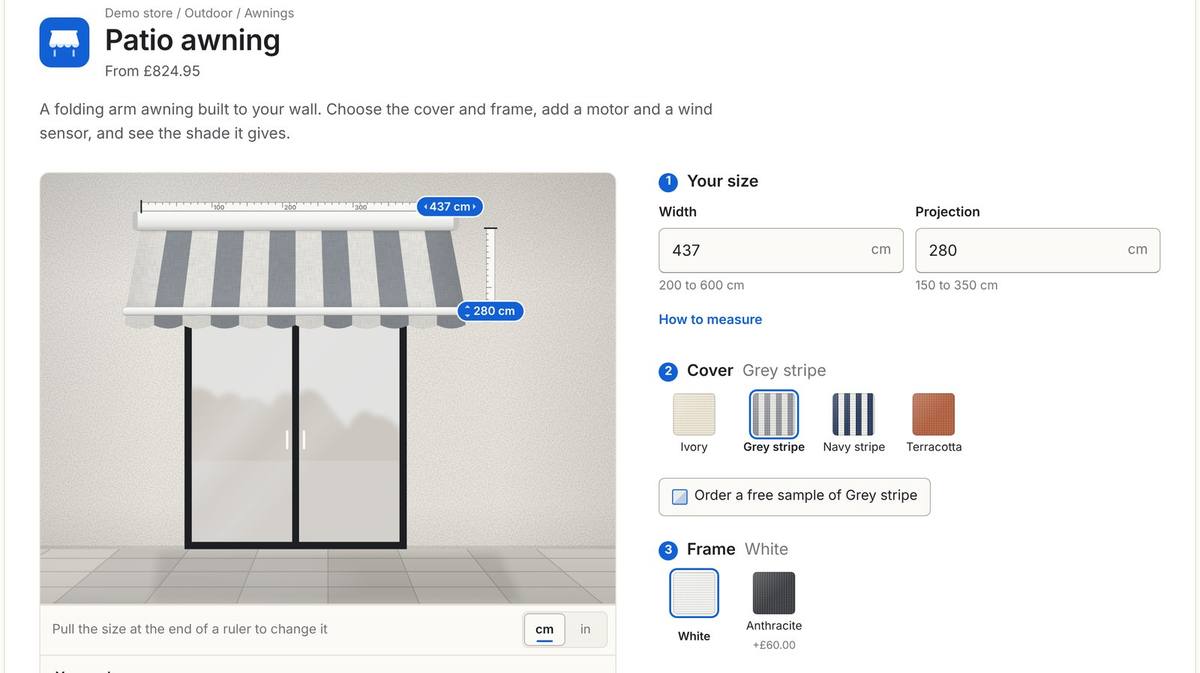
It starts from the size. The shopper types 437 cm by 280 cm, the awning is redrawn at that size, and the price is looked up in your grid: up to the 450 cm column and the 300 cm row, £1,612.95 in the demo with a grey stripe cover, a white frame and a hand crank. Nobody emails you for a quote, and nobody builds 80,601 variants.
For team wear it starts from the team. Every size goes on one page, every shirt counts towards the team price, and each size lands on its own basket line. In the demo, 23 navy shirts in four sizes come to £566.03. How to take a team t-shirt order in every size in one go shows the whole order.
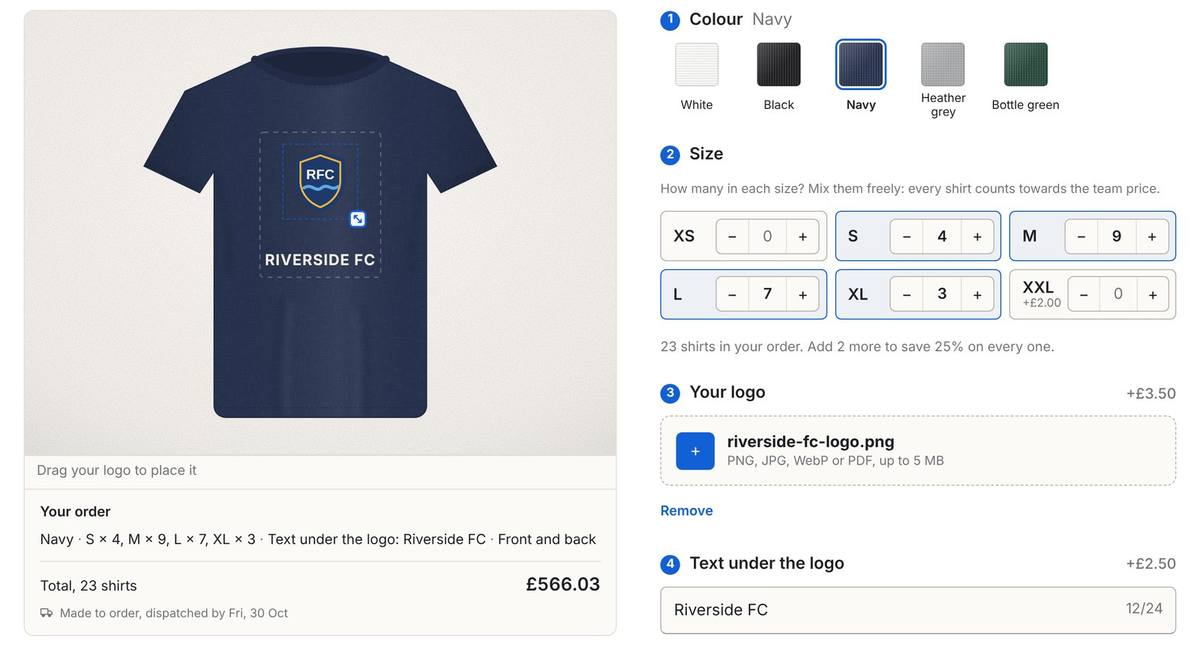
Then the checkout. Inchy works the price out again at checkout from your rules, on every Shopify plan, so the page and the checkout always match; why checkout prices can differ from the product page explains why that matters. And every size and choice lands on the Shopify order, ready for the production sheet described in how to print a production sheet for made to order orders.
Questions and answers
Can I keep variants for my stock products?
Yes. Inchy shows only on products where you have set up a builder. Your other products stay as they are.
Do I need Shopify Plus?
No. Inchy works on every Shopify plan, and the checkout price is worked out again from your rules on all of them.
Will it change my theme?
No. It is a theme app block for Online Store 2.0 themes that takes your theme's fonts. Nothing is changed in your theme files.
How is it different from a product options app?
Inchy also prices by size from your own price list, draws the product at the shopper's size or with their logo, takes team orders across sizes, and sells quantity offers and bundles, all in one app.
What does it cost?
$19.99 a month on Team wear, for products priced per item, and $99 a month on Made to measure, for products priced by size, with every look and style and Bundle kits. Unlimited products on both, billed by Shopify, with no fee per order. Shops that want it set up for them can ask about a custom plan.
Who makes Inchy?
InterioApp. We have priced and sold made to measure products since 2011, in our own shop first, and our quoting software and calculators are used by made to measure businesses in the UK, Europe, Australia and New Zealand.
Take one product you now sell as a list of standard sizes and set it up priced by the centimetre. See Inchy and try the live builder. Start the 7-day free trial on the Shopify App Store.
Sources
Shopify, 2048 variants: limit raised from 100 to 2,048 variants per product, published 15 October 2025.
Shopify Help Center, Adding variants: up to 2,048 variants and up to three options per product; prices added to each variant; a third-party app or line item properties beyond those limits.
Shopify.dev, line_item: line item properties are custom information, a name and value pair.
Shopify.dev, Cart Transform Function API: changing prices only through the Cart Transform API; only development stores or Shopify Plus stores can use apps with update operations.
Inchy website and live demo: size limits, choices, sample UK prices and the team order, read on 21 October 2026. Size counts worked out from the demo's limits and choices.
Written with AI. Every figure is checked against the sources listed above.
1reading now
Written by
 Inchy: Made to Order Builder for ShopifyShopify app10 pieces · 6 followers
Follow Inchy: to see new posts in your feed, on your phone or by email.
- views